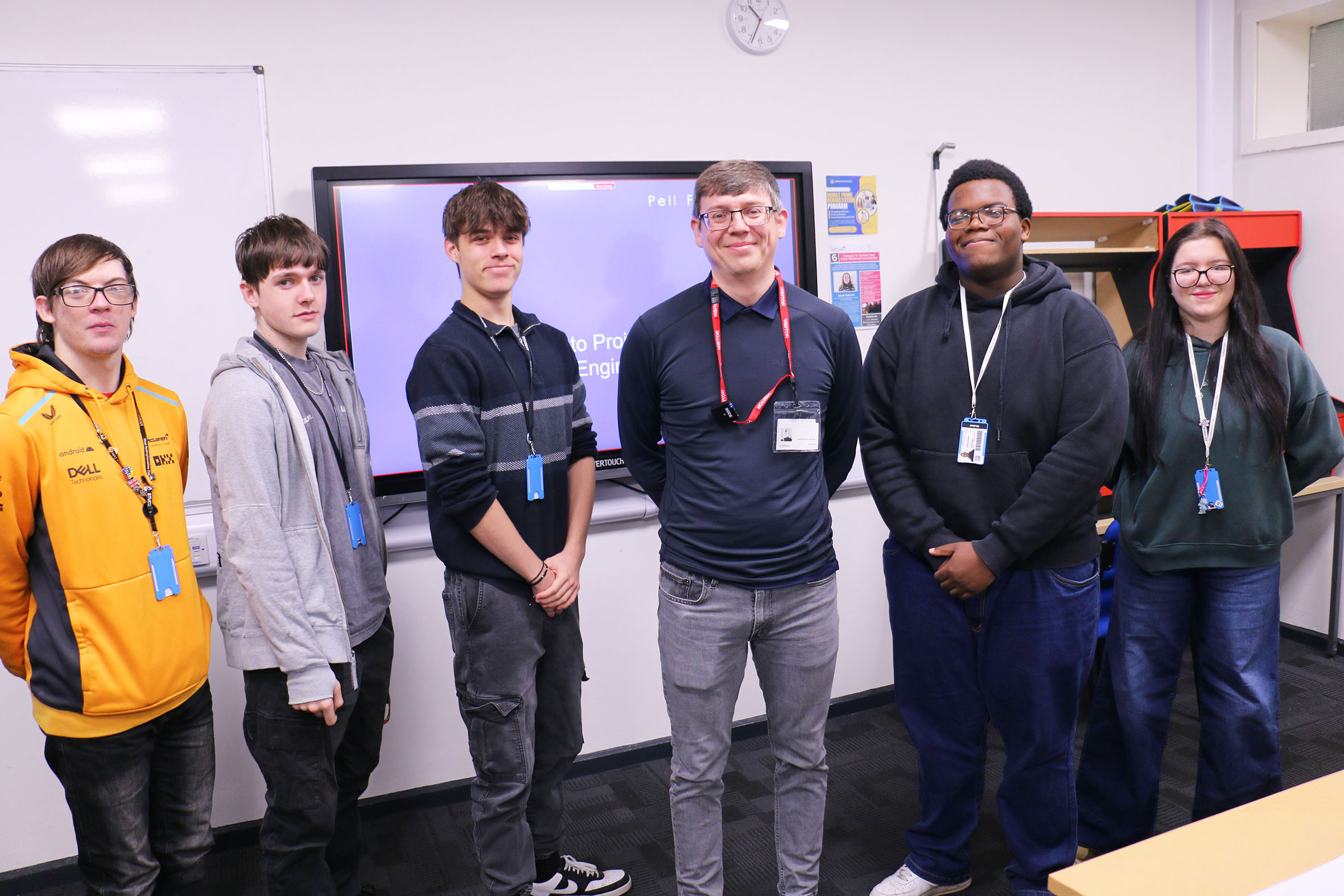
Information Technology students at West Nottinghamshire College have gained a fascinating insight into the world of civil engineering, discovering how digital technologies, project management and communication skills combine to deliver major infrastructure developments.
Lawrence Hulka, associate engineer at engineering consultancy Pell Frischmann, visited students studying the Advanced National Extended Diploma in Information Technology to share his industry experience and demonstrate how the principles they are learning in the classroom are applied to real-world projects.
The visit was organised by programme area leader Aaron Hulka, Lawrence’s brother, to help students understand how project management techniques and digital systems are used across different industries.
During an engaging presentation, Lawrence took students through the various stages of managing a civil engineering project, from initial planning and feasibility assessments through to detailed design, construction and completion.
Drawing on his own professional experience, he explained how engineering consultancies work with clients to transform development ideas into reality, highlighting the importance of careful planning, financial management, collaboration and effective communication.
Students heard about several major infrastructure schemes Lawrence has been involved in, including the Banwell Bypass near Weston-super-Mare and developments around East Midlands Airport.
He also demonstrated how specialist software and digital technologies, including Computer-Aided Design (CAD), 3D modelling and Building Information Modelling (BIM), enable engineers to visualise complex projects, identify potential problems and coordinate work between different teams.
The session explored the use of project management platforms such as Viewpoint, Procore and Dalux, which provide centralised systems for sharing technical drawings, managing documentation, monitoring progress and maintaining communication between contractors, consultants and clients.
Lawrence explained how these technologies help improve efficiency, reduce errors and ensure everyone involved in a project has access to accurate, up-to-date information.
However, he emphasised that technology alone cannot guarantee the success of a project, stressing that strong communication, sound judgement and effective working relationships remain essential.
Lawrence said: “The systems are only as good as the user. What you put into it, you will get out. But when you eventually enter the industry, whatever industry you choose, your communication skills are the thing that will set you apart from others.”
Students also learned about Lawrence’s own career progression, having entered the engineering industry in 2012 as a trainee technician with A Levels before completing further qualifications through part-time study while working.
He subsequently progressed through several engineering roles, demonstrating that there are different routes into professional careers and opportunities to develop through continued learning and practical experience.
During a question-and-answer session, students explored the growing influence of artificial intelligence (AI) within engineering and its potential impact on future employment.
Lawrence explained that while AI is increasingly being explored within his industry, human expertise remains crucial, particularly when interpreting technical information, applying appropriate standards and making important decisions.
Aaron Hulka, programme area leader for information technology at the college, said: “Providing students with opportunities to explore how technology and transferable skills are applied across different industries is what sets them apart.
“By connecting classroom learning with real-world experiences, we’re developing well-rounded individuals who will have not only technical expertise, but also the communication, planning and project management skills needed to succeed in higher education, apprenticeships and future careers.
“Lawrence’s visit shows that the skills developed through computing extend far beyond the technology sector, opening doors to opportunities across a wide range of industries."
For the students, the visit provided an opportunity to see how the skills they are developing through their qualification can be applied beyond traditional IT roles, particularly in industries where digital systems, data management and technology are increasingly central to everyday operations.
Advanced National Extended Diploma in Information Technology student Esther Olusesan said: “I found Lawrence’s presentation really interesting, especially when he spoke about his workplace, Pell Frischmann, and showed us some of the software they use in engineering and how it is applied in real projects.
“It was interesting to see how project management connects with different industries, including engineering, and how technology plays a role in managing projects.
He also spoke to me and my friend about apprenticeship opportunities we could explore, which was really helpful as it gave us a better idea of the career paths available to us after college. The session definitely encouraged me to think more about the opportunities available and the different routes I could take in the future.”