By Nicola Perkins, Founder of FE HR Hub | August 2026
How good intentions can quietly create dependency on HR – and why the start of a new academic year is the perfect time to reset the balance.

As colleges prepare for another academic year, there will be plenty of conversations about priorities, performance and plans. But there is another reset worth considering.
Who actually owns people management in your college?
The answer is almost certainly: our managers.
But take a closer look at what happens in practice and the answer can sometimes be rather different.
· Who leads the attendance management meeting?
· Who has the welfare conversation with an employee who has been absent?
· Who tackles the first signs that someone's performance is slipping?
· Who prepares for the difficult conversation when behaviour isn't quite where it needs to be?
And perhaps most tellingly: Who does the manager expect to be sitting beside them when they do it? Increasingly, I think this is a conversation worth having. Because in trying to be responsive, supportive and helpful, HR teams and organisational leaders can sometimes create something neither intended: a culture of ‘accidental dependency’.
When helpful HR becomes too helpful
Helping managers navigate difficult people situations is an important part of HR's role. We bring knowledge of policy and employment law, an understanding of risk and, often, the experience that comes from having supported similar situations many times before. It is therefore entirely understandable that, when a manager is faced with something difficult or unfamiliar, HR's instinct is to step closer.
That support can take many forms. We might attend an absence management or welfare meeting, help a manager prepare for a difficult conversation, draft correspondence or suggest the questions that need to be explored. In more complex or sensitive situations, close HR involvement may be both necessary and entirely appropriate.
The challenge arises when that additional support gradually becomes the default. What began as a response to a particular manager, circumstance or level of risk can, over time, become simply “the way we do things here”. HR attends because HR has always attended; drafts the letter because HR has always drafted the letter; leads the conversation because that is what managers have come to expect.
And this is where well-intentioned support can begin to have unintended consequences.
When HR routinely takes on something a manager could reasonably have been supported to handle themselves, we may solve the immediate problem while making it less likely that the manager develops the confidence and capability to handle the next one.
The culture of ‘accidental dependency’
This was one of the themes that generated some particularly interesting discussion during our FE HR Hub Summer School. We looked at the things HR teams routinely find themselves doing every day.
Some of these will be familiar to many HR teams: routinely attending meetings without really questioning what our role needs to be; drafting correspondence from scratch when a manager could have done the first draft; providing the answer rather than helping someone develop their own judgement; or stepping in when a conversation becomes difficult or uncomfortable.
Pressure and urgency can reinforce the pattern. When something needs resolving quickly, it can feel easier for HR to take it on than to spend time helping a manager work through it. We may find ourselves chasing actions, compensating for repeated avoidance or quietly taking ownership of something because we know it needs to get done.
Taken individually, these can seem like small and perfectly understandable acts of support. The issue is what happens when they become routine. Gradually, the boundaries around who owns what begin to shift and behaviours that were intended to help can start to shape expectations – both of HR and of managers themselves.
None of this happens because somebody has consciously decided to make managers dependent on HR. More often, it develops out of entirely understandable intentions. An inexperienced manager needs additional support, so HR stays close. Someone is anxious about getting a difficult conversation wrong, so an HR colleague sits alongside them. A college is under pressure and an issue needs resolving quickly, so the Business Partner takes on a little more than they ordinarily would. A senior leader wants reassurance that a sensitive matter is being handled properly, so HR becomes more closely involved.
In the moment, these can all be perfectly reasonable responses. And, importantly, they usually work. The meeting happens, the letter gets written, the difficult conversation takes place, and the immediate problem is resolved.
It is precisely because these responses work that they can so easily become established practice. Before long, “Could you just join the meeting?” becomes “HR normally comes to these.” A request for help drafting one particularly difficult letter can gradually become an expectation that HR drafts them all. Additional support, offered for good reason, quietly becomes part of the way the organisation operates.
This is what I mean by ‘accidental dependency’.
It isn't created by managers alone, nor is it simply the consequence of an HR team being too willing to help. It develops through the habits and expectations that HR, managers and senior leaders create together.
There is an irony here too. The more capable and responsive an HR team is, the easier it can be for this pattern to take hold. Managers know that HR can sort the problem, will know what to say and will make sure the process is handled properly. In a busy organisation, turning to that expertise can feel like the safest and most efficient option.
But over time, we need to ask what that efficiency is costing us.
Capability sitting within HR isn't the same thing as capability existing across the organisation.
And if our ambition is to build confident managers who genuinely own their people responsibilities, that distinction matters.
Supporting isn't the same as owning
One of the most important boundaries for HR, therefore, is the boundary between supporting managers and managing for them.
Take attendance management: the employee's day-to-day relationship is with their manager. It is the manager who needs to understand what's happening, maintain appropriate contact, explore what support may be needed and manage attendance fairly and consistently.
HR has an important role in that process. We can advise. We can coach. We can help the manager prepare. We can make sure the process is fair and that legal, policy and wellbeing considerations have been properly understood.
But does that automatically mean HR needs to be in the room? Sometimes yes. But certainly not always. What does HR's presence add? And perhaps more importantly, what happens to manager capability when HR is always there?
The same question applies to welfare conversations, informal performance discussions and many of the other everyday people matters taking place across our colleges. Rather than assuming HR should be present, it is worth considering what our involvement will actually add – not only to the situation in front of us, but to the manager's ability to handle similar situations in the future.
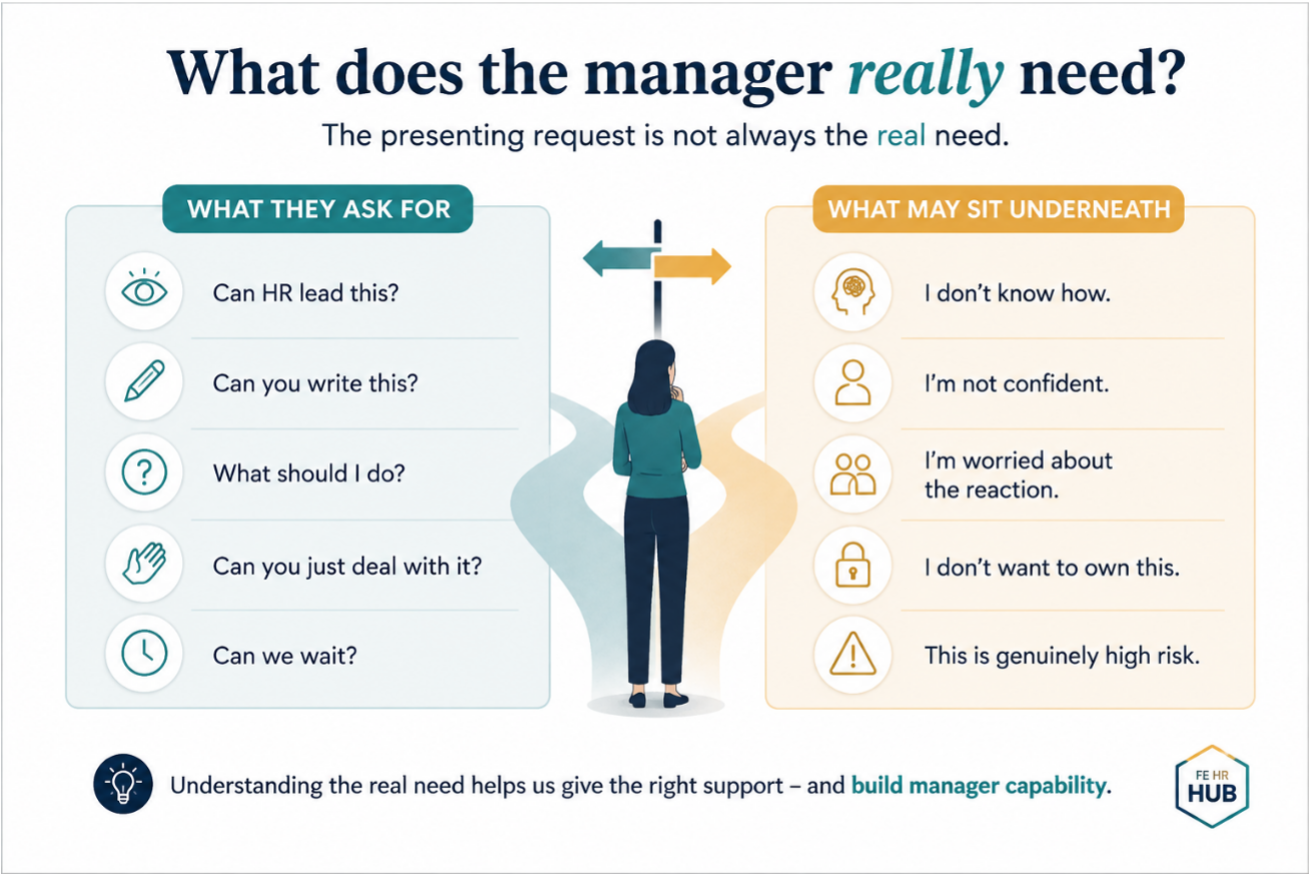
That starts with looking beyond the request itself. What a manager asks HR to do isn’t necessarily the same as what they actually need from us.
Support that builds capability
Another theme we explored during Summer School was the distinction between being kind and being nice. It is a deceptively simple idea, but an important one when we think about how HR supports managers.
Being nice can mean making something easier for someone in the moment. Being kind can sometimes mean resisting the temptation to do that and instead providing the support and encouragement that enables them to do something difficult for themselves.
When a manager asks, “Can you come to this meeting with me?”, therefore, an automatic “Of course” may not always be the most helpful response. There may be good reasons for HR to attend, but equally, the manager may need something different: an opportunity to talk through what they are worried about, to prepare for the conversation, to test out how they might approach it and to know that HR is available if they need advice.
That approach asks more of the manager, but it also gives them the opportunity to develop confidence through experience. Having successfully navigated the conversation themselves, they are likely to approach the next one with greater confidence and less reliance on HR.
For me, that is an important measure of effective HR partnering. Our support should not simply help managers through the situation they are facing today; wherever possible, it should leave them better equipped to handle the situation they encounter tomorrow.
The boundary isn’t always in the same place
Healthy HR boundaries aren't about stepping away from managers or retreating behind “that's not our job.” The reality is much more nuanced. Good HR partnering means adapting our approach according to the circumstances, the level of risk involved and the capability and confidence of the manager.
A relatively inexperienced manager dealing with their first complex absence case, for example, may need HR to stay very close, helping them prepare and supporting them through the process. An experienced manager dealing with a more straightforward situation may need little more than an opportunity to sense-check their approach beforehand. Equally, there will be sensitive or high-risk employee relations matters where direct HR involvement is entirely appropriate, regardless of the manager's experience.
The important thing is that the level of HR involvement is a conscious choice rather than an organisational habit. Our role might be to advise or coach, to challenge a manager's thinking, to work alongside them or, where appropriate, to step back and allow them to take the lead. Effective partnering means judging what will best support the situation in front of us while continuing to build the manager's confidence and capability.
Perhaps, therefore, the question isn't simply: should HR be involved? But rather, what level of HR involvement will help this manager deal with the situation well, while building their capability for next time? That's a very different starting point.
Manager capability doesn't develop by accident
We talk a great deal across FE about developing leadership and management capability, but that development doesn't happen only through formal programmes, workshops or training courses. Much of it happens through experience, in the everyday moments when managers have to put their skills and judgement into practice.
A difficult sickness conversation, an early discussion about underperformance or a welfare meeting where an employee becomes upset can all feel uncomfortable, particularly for a manager encountering the situation for the first time. Yet these are also important opportunities to develop confidence, judgement and the ability to handle increasingly complex people situations well.
If HR routinely steps in to remove that discomfort, there is a risk that we also remove some of the learning that comes with navigating it. The aim shouldn't be to leave managers to struggle, but to provide the right level of support so that they can work through these situations successfully and become better equipped to handle the next one.
Over time, that changes the relationship with HR. Rather than looking to HR to take responsibility for difficult people matters, managers begin to draw on HR for advice, perspective and expertise while retaining ownership themselves.
And just as ‘accidental dependency’ can develop gradually, so too can capability.
Each time we support a manager to handle something well rather than handling it for them, we're investing in the capability of the organisation – not simply resolving the issue in front of us.
A useful reset for the new academic year
So, as another academic year begins, perhaps this is a useful conversation for HR teams and senior leaders to have together. Because healthy HR boundaries cannot be created by HR alone. If senior leaders routinely ask HR to step into management issues, if managers are rewarded for escalating rather than resolving, or if HR attendance has become the organisational badge that says, "this is being handled properly", the dependency is being reinforced from both sides.
Look at where HR time is currently going. Look at the meetings HR professionals routinely attend. Look at the conversations managers feel unable to have without HR. Look at the things your HR team does every day simply because "HR has always done them."
And ask:
- “Does HR genuinely need to be doing this?”
- “Who should really own this conversation?”
- “Are we reducing organisational risk – or simply reducing managerial discomfort?”
- “Are our organisational habits building manager capability – or accidental dependency?”
And perhaps the most important question:
Is the way we currently support managers making them more capable, or more dependent?
This isn't about HR doing less for the sake of it, nor is it about leaving managers unsupported. It's about creating healthier boundaries and stronger relationships – where managers understand that managing people is an essential part of their role, leaders reinforce that expectation, and HR professionals have the confidence to support without automatically taking over.
Get that balance right, and we not only build greater management capability across the organisation; we also create the capacity for HR to focus on the bigger workforce, culture and organisational challenges facing FE.
Sometimes the most supportive thing HR can do is step in. Sometimes it's to stand alongside. And sometimes it's to help a manager realise they're ready to take the next step themselves.
Perhaps the start of a new academic year is the perfect time to ask, “Have we got that balance right?”

About the author
Nicola Perkins FCIPD is the Founder of FE HR Hub, a specialist community connecting and supporting HR professionals and leaders across Further Education. Through the Hub, Nicola brings together sector-specific insight, practical resources and development opportunities designed to strengthen people practice, build leadership and management capability and help FE colleagues connect, share and grow together.